

When we talk about the music of the '90s, it's often discussed in somewhat monolithic terms that focus on the rise of grunge and/or "alternative." The reality, though, is that the decade's Top 40 was a lot messier and more varied than hindsight might suggest; for at least a few years, it felt like decades of tribal pop listening habits might have started to break down, leading audiences to a place where genres could cross-pollinate freely, and there was room for new levels of experimental indulgence on the mainstream airwaves.
It didn't happen at the turn of the decade, though, and it also didn't happen all at once. And for every act that broke through by touching a slightly different set of wires together in order to jump-start a fresh pop spark, there were dozens whose efforts were overlooked — victims of bad luck, bad timing, or some combination of both.
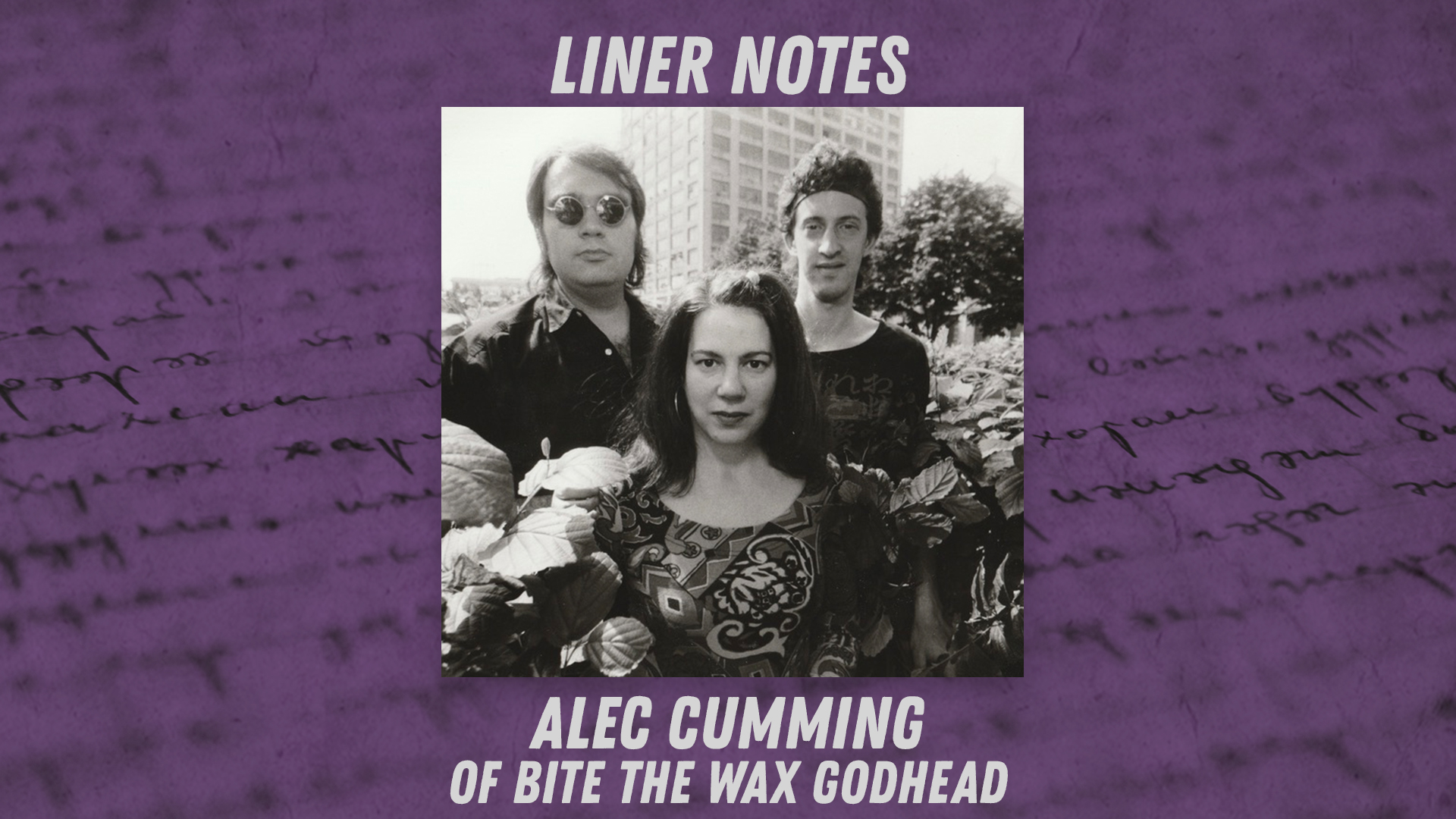
This is the story of Bite the Wax Godhead — or part of it, anyway. Fronted by husband-and-wife duo Alec Cumming (bass, guitar, vocals) and Cynthia Harden (keyboards, vocals), with six-string assistance from guitarist Larry "Screech" Horowitz, the group fused sweetly sincere Bacharachian pop with quirky hip-hop — a blend that produced commercial dividends later in the decade for numerous acts, but was too left-field to find widespread purchase while group was peddling its wares. Eventually, the hooks ran out, and so did the harmony; Cumming and Harden divorced, and Bite the Wax Godhead split.
But for a band most people have never heard of, BtWG produced an estimable legacy. Not just in terms of the music, which holds up a lot better than many might have guessed in the early '90s, but also in terms of the people who made it: Cynthia's neurological research helped alter the course of epilepsy treatment, Alec has done decades of work in TV and music production, and their daughter, Julia Cumming, is a highly respected musician in her own right, both as a solo artist and as the frontwoman for Sunflower Bean.
Speaking as someone who heard those Bite the Wax Godhead tracks as they were released, I can attest that they were well-written and engagingly performed enough to burrow their way into a listener's brain for decades — every so often, out of nowhere, I'll find myself remembering the classic Cynthia Harden line "I said 'Listen, asshole, you're coming over today / Or I'm calling up Larry, or Steven, or Jay / So don't delay to relay, or it will result in melee / Boyfriend, you're showing obvious signs of decay.'" It stands perfectly to reason, then, that Alec found himself coming back to those tracks in recent years, looking for a way to give them a proper release during the digital distribution era.
His mission wasn't purely nostalgic. He was also driven by a desire to pay tribute to Cynthia, whose unique songwriting sensibilities were a huge part of what continues to make the group's music so enduringly special. She'd long since set aside her recording career to focus on her work as a world-renowned neurologist, but those songs still hold up. He also had another reason to resurface those records: Cynthia's glioblastoma diagnosis, which altered her life irrevocably when it was handed down in 2023.
We conducted this interview with Alec in early May, and before it was ready to publish, we received word that Cynthia had died. Her passing casts a pall over the conversation, but it's a bittersweet one; in every word of this transcript, it's impossible not to feel the continued fondness and deep admiration that still existed between Cumming and Harden, long after their personal and creative union came to an end. All proceeds from the reissued Bite the Wax Godhead recordings and new merchandise — which we hope to offer here at Harmonic soon — are being donated to the Glioblastoma Research Organization.
I can't talk to you without, of course, talking about the Hungry Dutchmen. You and Cynthia were in another band prior to starting Bite the Wax Godhead, and I guess I’m interested in getting kind of a loose picture of your frame of mind at this point. I don’t know if you looked at it as like, "The Hungry Dutchmen got close, but never quite grabbed the brass ring, and I think I know maybe what not to do this time." Were you approaching it from that standpoint, or was it just like, "That band is over, this is a new band, and this is what I want to do"?
Well, I’ll give you the honest answer. Maybe it’s too honest. But yeah, the Hungry Dutchmen, we started off amazingly. We had an MTV Basement Tapes award-winning video.
That was kind of our high. The rest of the career was downhill. And when I heard the Smithereens, I was like, "Shit, they did it." What the Smithereens did was kind of what we were aiming at, and, well, there can’t really be two Smithereens.
I loved playing in the Hungry Dutchmen, and yes, that’s where I met Cynthia. But I felt like, looking back at it, and also looking back at Bite the Wax Godhead, we didn’t schmooze enough. We were too insular.
A musician friend pointed this out to me a while ago: if you want to be in a band and you want to get into a community of bands and get people to recommend you, go see other people’s gigs. Hang out, talk to people. Whereas I felt we were just going out to the Nutley, New Jersey studio and getting high and getting drunk and thinking that we were the best. But we really weren’t.
As the Dutchmen broke up — [lead singer Tony Faske] was losing interest, he kind of felt like he wasn’t really, you know, had the chops to be a major-label singer. And we were just too kooky to kind of fit into what anybody would be signing anyway. And [drummer Mike Bowman], my best friend, wanted to do his own music stuff.
Meanwhile, Cindy had joined the band, and she had a boyfriend, which I found out the night that we auditioned her because I thought she was amazingly hot immediately and really mysterious. And when Tony and I dropped her off, I was like, “Is she single?” And he’s like, “No, she’s got a big Puerto Rican boyfriend.”
Eventually, Cynthia and I were having a surreptitious affair, hiding it both from her boyfriend but also from the band, which engendered some bad feelings. So when it all came out, there was sort of like a bad vibe going on. And I think we were all kind of losing interest and losing our confidence that we were going to do something good.
For a while I thought, okay, great, I’m going to go out and start my own band. Or I’m going to be a songwriter, or I’m going to do something at a higher level. But by then, Cynthia was my girlfriend.
And I was spending every available minute with her. Cynthia was my first real girlfriend. She was like, “I’ll play some keyboards.” And then she was bringing songs to the four-track and she would play on them and I would play on her songs and record them. Eventually it was like, “Well, why don’t we do something together?” And that’s how it started.
We made a four-track demo tape for our own fun. We didn’t really think it was going to go anywhere in particular, but maybe something would develop from it. We gave it to a guy named Bob Racioppo, who used to be a member of the Shirts, the legendary CBGBs band.
Bob was the head of this scene of bands called the Brooklyn Beat. I don’t know if you’ve been noticing, but there was a premiere of a documentary about the Brooklyn Beat, and Bite the Wax Godhead is featured in it. The movie is called Before It Was Cool: The Brooklyn Beat at Lauterbach’s.
It really was before it was cool. We were like the first bands to sort of — the newspapers, the press we got would be like, “Can you imagine it? Go out to Brooklyn, to Park Slope, and there are cool rock bands making music.”
So Bob Racioppo loved the demo tape. We were different. We weren’t like the typical band handing him a tape, because it was the two of us doing like a rap song here and a movie-theme cover there. He wanted us to be weird. He wanted us to be different. So he was like, “I’m going to give you a gig two weeks from now.”
We quickly found my friend Larry Horowitz, who was my only high school friend who I was still in touch with. Really nice guy and a very good guitarist, very melodic. He came on board, and he had a car so he could drive us to gigs.
We played our first gig at Lauterbach’s, and so we are considered one of the Lauterbach’s bands, even though I think to a certain amount of the fans who went there, they were just confused by us or they hated us because we used a drum machine.
Backing up a bit, I would take the Dutchmen over the Smithereens any day.
Thank you. We were really, really good. The very first tracks, “Alone on a Saturday Night,” and there were a couple other songs recorded at those sessions — the lead guitarist was a guy named Cary Berger, who was in a band called the Wind.
Cary was what a band needs. He was a hipster. He was like a 1986 hipster. He knew the guys in Wire, he knew the cool clubs to go to, and he was a talented, inventive guitarist.
He brought us into Water Music in Hoboken, which was a really hip studio. I always feel — and I was just talking to Cary about a week ago — if he had stayed on, I think we would have had a leg up.
We replaced him with Paul Rose, who was one of our Syracuse buddies. There are tapes of us playing live that were just ferocious. We were really, really rocking.
We could be really good. We were just sort of losing confidence. Tony — when you have a lead singer, you need a lead singer who’s like, “I’m going to do it, man.” And he was steadily losing confidence. We were getting stagnant.
Well, my point in bringing that up is not to belabor the Dutchmen. It’s really just to say: you mentioned the drum machine and how that set people back, and that was my first reaction when I heard the Godhead stuff.
One of the things that was really appealing to me about the Dutchmen was that it sounded like a high-wire act. You didn’t know if the band was going to be sweet and melodic or rip your face off. There was a lot going on, and it sounded like people doing unpredictable things and coming together in the same room.
Whereas the Godhead stuff sounded more assembled. So that kind of took me aback. Since you brought up the drum machine, I wonder: you set out to start a new band. How did you arrive at that sound? Keyboards, drum machine, guitar?
There's a funny story. Later on in the waning months of the Hungry Dutchmen, we had sent out our latest demo tape to a fanzine written by a guy we knew from Syracuse who was a real punk rock guy. He gave us a bad review and said, “If I were in the Hungry Dutchmen, I would listen to a lot more Dinosaur Jr.”
That pissed me off in the worst way. It made me think that indie rock had its own code of ethics. Like, “This is what indie rock should be.” And I thought: I don’t want to do that.
Cynthia wasn’t someone who cared about what the current cool thing in rock and roll was. She liked dance music.
Right around then, this is 1989, De La Soul came out with 3 Feet High and Rising. Yo! MTV Raps was getting really creative. Young MC was doing great raps. And Cynthia’s raps, to the end, were all very lighthearted in the style of Roxanne Shanté or early harmless rap songs.
Of course, as white people rapping — and Cynthia being a neurologist rapping — we started to get crap. “Who do they think they are?”
But for me, it wasn’t so much that I craved the drum machine. It was an easy way for Cynthia and I to make up songs quickly. A lot of the music I was listening to by then had drum machines on it. I started to like house music because it was so desperate and insistent. I came over to Cynthia’s way of thinking about how great dance music was.
To me, the most creative thinking at that point in history — ’89, ’90 — was coming from hip-hop guys more than from “Let’s be another Pixies.”
So it was really me consciously saying, “I don’t give a shit.” I realized I wanted to be a real songwriter who wrote precise songs. We weren’t going to slide by on just a powerful rhythm section or distorted guitar. We were going to make songs almost like baroque pop. That worked against us in some ways because Cynthia and I did not have the best voices. If you’re in a loud, distorted band, you can get away with crappy singing. But we were laying ourselves naked to the world.
So anyway, we wanted something different to do. I was sort of defiantly anti-rock at a certain point. And also I was super into Cynthia.
You also mentioned the difficulty of selling the Dutchmen. So for your next act, you start a band that has a name that needs to be explained and a sound that’s sort of neither fish nor fowl.
It’s not any easier to sell to a label at that point in time than the Dutchmen would have been. Did you have aspirations in that direction as Bite the Wax Godhead was starting out? Did you have a game plan? Were you maybe looking at They Might Be Giants and thinking, "Well, maybe…"?
There’s no single bigger influence on what we were trying to do than They Might Be Giants, which was two nerdy guys with a drum machine. I was worshipping They Might Be Giants then. I’m like, okay, we’re going to be like that. An art-rock band using a drum machine. One song will be a dance song, one song will be a ballad, and we won’t be pinned down.
The name, by the way — I regret that we were called Bite the Wax Godhead.
It was a stoner joke we had at rehearsals. “Bite the Wax Tadpole,” and then I changed it to “Godhead.” Then I wrote it on the side of the cassette I gave to Bob. And Bob was like, “I want to give Bite the Wax Godhead a gig.” So we didn’t change it.
What I don’t like about it is that it’s not easy to explain and it doesn’t make sense. It led people to think we were something other than what we were.
Part of the backdrop for my question is that this was a point in time when being niche was not necessarily a strength. If you didn’t have distribution, you were paying upfront to make physical product and hoping you could get it in stores.
You’ve got this trio and you’re quirky, and you don’t have the kind of thing where you could just walk into a label and say, “We’re the next whatever,” and they’re going to hear platinum sales.
We were signed to a demo deal by Chrysalis Records in mid-1991, but I’m pretty sure the A&R person sold us as maybe the new Vanilla Ice because Cynthia was a gimmick.
She was an attractive woman, she was a neurologist, and she liked to rap. A white woman rapping was pretty rare back then.
There was novelty value there.
But the reality was we were a band that did rap songs, but we also did pop songs. We made demo tapes and sent them to record companies, but our models were more like De La Soul or They Might Be Giants. We thought there would be a really smart record label that could channel us into something where we’d at least make a couple of well-reviewed albums or fill clubs in New York City.
I’m not sure if our ambitions went beyond that.
What’s striking to me is that when you started making music together and sending out tapes, the industry was in a place where you would’ve been extremely difficult to pitch, but the music was really ahead of its time in the context of the decade. There was this explosion of eclecticism in the mid-’90s where labels were actively hunting for indie acts they could throw money at.
Do you ever look back and think: if we’d started just a little later, who knows what could have happened?
I’ve absolutely thought that. I think we were ahead of our time.
Even just the idea that we wanted to mix indie music with dance music — that became a bigger thing throughout the ’90s. At the time, if you were a band that did a rap song, people would walk up to me and say, “I hate rap. Rap sucks.” But I was listening to a lot of rap and I saw it as an art form. I was very open artistically. What does the song need? Maybe the best bass line is a repeating bass line that just drives the groove home.
I was trying to get away from the white rock-boy mindset. I was always about what was going to serve the song.
I want to segue from that into your songwriting, because I think the stuff you did for Godhead was also ahead of its time. I hear more now than I did then how intensely and deliberately you were channeling these classic pop influences. I listened to “Transportation” the other day and thought: this is something Brian Wilson might have made during that weird period in the ’70s.
Lyrically, it’s extremely strange and specific, but also utterly sincere. And it has this hook that sticks in your brain. Those things would be much more respected later in the decade than when you were making this music.
I’m a huge Bacharach fan. Later in the ’90s I spent years working on a Burt Bacharach box set. Huge Beach Boys fan. Even if you listen to the surface of the music, people have a hard time listening past the surface of the Wax Godhead music. But if you dig deeper, you can hear what we’re doing.
“Transportation” is almost autistic-ish or OCD-ish in the way it’s obsessing over trains and planes and movement. It’s really a celebratory, sweet song. It’s one of the best songs we ever did. And “Lies and Promises” — we worked very hard on that as a classic pop song. We were sweating the details.
That 1991 period, right before Cynthia and I got married, was very fertile creatively. But then the freshness of what we were doing started to get lost in the day-to-day normalness of being a married couple. Arguing about songs and then going to bed angry. It was a pretty good example of why married couples don’t do well in music.
So this lasts until the late ’90s, right?
Yeah. The last set of songs — the stuff that became Whisperjets — there are some really good songs in there. But sadly, 1998 was not a good year for our marriage. I ended up putting a lot more attention on those songs than Cynthia did. She showed up, did the basic tracks, and kind of let me do the rest.
So those songs never really came out. They just sat gathering dust since 1998.
And there are some really good songs there.
I’m glad you can hear that now. The music must be tied up with what you were feeling at the time.
The married couple bickering thing really hurt us. And it made me undervalue the music for a very long time. I thought I squandered my talent. But I don’t regret it now. That was what was supposed to happen. And I’m very proud of what we were.
What makes me sad is that songs like “A Million Dollars” and “You Never Said Goodbye” are very angry messages from me to Cynthia. “A Million Dollars” is basically asking: “Will you love me once I make a million dollars?” Because we were having money problems.
There’s actually a New York Times article about our divorce.
That’s rough, having your divorce in the New York Times.
I actually said yes enthusiastically because they were doing a series about divorce. But I realized I wasn’t good with money. Cynthia was sensible about that stuff. I had some growing up to do.
After the divorce and the end of the band, I basically went on strike as a songwriter. I just thought: fuck it. I put all my energy into being a dad and freelancing and trying to bring in money.
So now you’ve snapped this nearly 30-year hiatus. You’ve been able to hear and appreciate the value in this music. What would be even more beautiful is if this reawakened the muse in you somehow.
You’re a tremendously talented songwriter. And we’re now at a stage in history where you can do everything you need to do from the room you’re sitting in right now. Do you still have that in you?
You’re very kind.
Yes. I have said so many times: I want to write songs again. I want to play gigs again. I think I still have access to songs, not to mention I have literally hundreds of song ideas from back in the day.
My wife Kristie is always encouraging me to write again; to my left is a music room specifically set up so I can write songs again. So yes, I would love that. I think it would be a shame if I didn’t write songs again.
I think it would be a shame too. What appeals to me most about stories like this is when stuff is done for the right reason. When you’re doing it because it’s in you and it needs to come out. I mean, how long did Emitt Rhodes go between making records?
Thank you for saying that. It gives me encouragement. If I sell 20 copies, great. If I sell 100 copies, great. I’m not expecting it to flame up the charts.
Although I’m super proud of Julia’s work. She’s writing Bacharach- and Carole King-inspired stuff, and the critics absolutely love it. I almost fainted when Pitchfork finally gave her a good review.
And yeah, she grew up in a household where being a songwriter was the highest thing you could aspire to. They were gods: Brian Wilson, Burt Bacharach, Elvis Costello, Ray Davies, Paul McCartney. So yeah, I’m incredibly proud of her.